MBA · Leadership Development Plan

Becoming
the Leader
I Choose to Be

Name Nguyen Anh Duong (25010217)
Lecturer Ms. Trinh Thuy Xuan Lan
Role Customer Experience Manager, Manulife Vietnam
Key Stakeholders
Operations IT Distribution Others
Role Requires
Strategy Formulation Cross-Functional Execution
Horizon July 2026 → June 2027
Career Goal

Grow into a CX leader and manager who builds and leads a high-performing team — one that drives innovative, impactful customer initiatives that shift how Manulife thinks about and serves its customers. To be the kind of leader other functions actively seek out as a strategic partner, not just a service provider.

12-Month Leadership Goal

Become an effective CX leader without formal authority — known for sound, decisive judgment, and recognized for fostering a cross-functional environment where people collaborate with purpose, grow through real accountability, and deliver successful project outcomes together.


Andie

Leadership Profile

Three frameworks. One honest picture of how I naturally lead — and where I need to grow.

I am a leader who is reliable in execution, strong in building individual trust, and continuously growing — but who defaults to the structured over the experimental, and to doing over enabling others.
Natural strengths: Telling & Selling Development target: Participating & Delegating — Situational Leadership, Hersey & Blanchard
MBTI

ISTJ

Introverted · Sensing · Thinking · Judging

ISTJ
I

Introvert

I process internally before I share. I need to validate my thinking before I put it on the table — which can read as hesitation in fast-moving rooms.

S

Sensing

I anchor to what is concrete and proven. I stress-test ideas before building them. This makes me rigorous — and sometimes a momentum-killer for early-stage thinking.

T

Thinking

I decide through logic, not feeling. I make hard calls. But I can come across as cold when people need to feel heard before they're ready to be reasoned with.

J

Judging

I'm most comfortable when things are decided and moving. Ambiguity is uncomfortable — which is a real gap in a role built on navigating strategy without certainty.

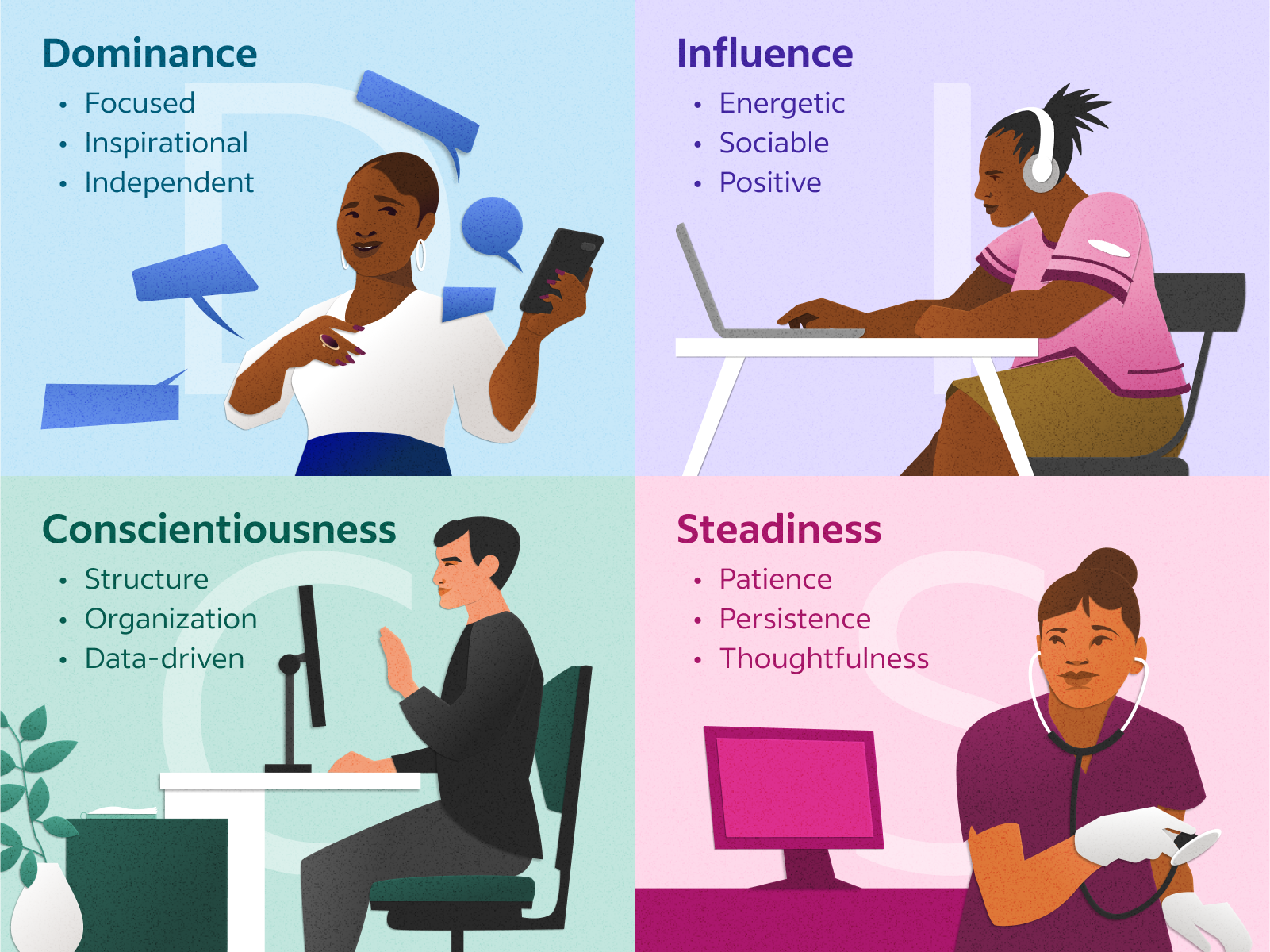
DISC

Influence + Steadiness

Primary behavioral profile

DISC
Influence (I)High
Steadiness (S)High
Conscientiousness (C)Moderate
Dominance (D)Lower

The asset: I genuinely enjoy connecting with people and I approach them as partners, not obstacles. Across Ops, IT, and Distribution, people want me in the room — because they trust me and feel that.

The blind spot: I+S prioritizes harmony. I delay or over-soften difficult things. In a role where developing people is the goal, this is a real gap that compounds.

CliftonStrengths

Top 5 Strengths

The pattern across these five tells a coherent story — with clear strengths and a predictable set of gaps.

① Learner
② Achiever
③ Arranger
④ Relator
⑤ Responsibility

Learner

Energized by new knowledge. Challenge: channel this into developing others, not just myself.

Achiever

High drive, high bar. Risk: instinct to own the work rather than let others grow through it.

Arranger

I see how pieces fit — people, timelines, priorities — and reorganize when it isn't working. My coordination engine in cross-functional work.

Relator

I invest deeply in a small circle. Gap: network is deep but narrow — compounds over time for a CX leader.

Responsibility

I own what I commit to — fully. Risk: tips into over-ownership. I fix problems others should solve.

The Pattern

Reliable. Trusted. Growing. But defaults to doing over enabling — and structure over experimentation.

Leadership Strengths

The foundation this plan builds on.

01

Execution & Reliability

I deliver what I commit to — consistently. In cross-functional CX projects, this reliability is foundational and earns me access to conversations beyond my formal title.

02

Relationship & Cross-Functional Reach

I invest in relationships fully — context, follow-through, genuine care. Over two years at Manulife, this has built real access across Ops, IT, and Distribution that goes beyond my role.

03

Continuous Learning & Adaptability

I learn actively and deliberately. When a challenge arrives without a ready answer, I go find the framework — not push through with what I already know.

Development Areas

Three honest gaps. Three deliberate targets. Grounded in the leader I need to become.

Innovation & Creative Leadership

Goal

Lead a CX function where bold, customer-first thinking is modelled from the top — and people feel safe to test before they're certain.

Gap

ISTJ instinct evaluates before it explores. I stress-test ideas before developing their potential. Teams that receive that consistently stop generating ideas.

Influence & Empower Without Authority

Goal

Mobilize stakeholders to genuinely commit and own deliverables — and develop the discipline to fully release control once direction is set.

Gap

Two patterns: stakeholders comply without commitment; and I hold on to quality — reworking, checking in beyond what's agreed. Others never develop real ownership.

Coaching & Feedback Capability

Goal

Give timely, structured feedback using SBI — and run GROW coaching conversations without defaulting to advice-giving or over-softening.

Gap

I+S protects relationships at the cost of honesty. Feedback gets softened or reframed so carefully the recipient misses the point entirely.

Action Plan

Three actions. Three gaps. One framework that runs through all of them.

10%
Formal Learning
Books and frameworks. Provides the mental model and language before real application begins. Front-loaded to months 1–3.
20%
Relationship & Feedback Loops
Manager debriefs, peer feedback, stakeholder check-ins. The accountability layer that keeps practice honest from month 4 onward.
70%
On-the-Job Practice
Decision logs, ownership maps, coaching sessions, feedback practice. Where real skill is built — through repetition, reflection, and iteration.
Action 01

Improve Decision-Making Quality & Speed

Addresses: Innovation & Creative Leadership
📅 July 2026 – June 2027
Objective

By June 2027, make faster and better-quality decisions by developing big-picture awareness, reducing over-reliance on data before committing, building trust in others' inputs, and consistently generating at least one unconventional option before defaulting to the conventional choice.

20% Relationships & Feedback Oct 2026 – Jun 2027
🗣️
Manager Debrief — Weekly
15–20 min each week debriefing 1–2 recent decisions: what data I used, how long I took, what bigger-picture or unconventional option I might have missed. Direct calibration against someone who has already seen my patterns.
🔁
Peer & Stakeholder Feedback — End of each project cycle
Not just whether the outcome was right, but whether my process was clear, inclusive, and moved at a pace that served the project. Ground-level feedback my manager can't provide.
70% On-the-Job Practice Oct 2026 – Jun 2027
📓
Decision Log — From Oct 2026 (via NotebookLM + Claude)
Every significant decision: data used, deliberation time, options considered, one unconventional option generated. Flag every decision taking over 48 hours. This makes the pattern visible.
Active: Month 4 Pattern review: Month 6
📊
Monthly Pattern Review
Where am I consistently slow? Where do I reach for familiar options? Where do I most resist trusting others' inputs? Monthly review surfaces what needs targeted work in the next phase.
🤝
Co-Created Decisions — From Jan 2027
Log decisions made with others: my first reaction, deliberation time, specific words used, how I felt. This is the part that requires trusting in real time, not just in theory.
Action 02

Increase Ability to Influence, Empower & Delegate Without Authority

Addresses: Influence & Empower Without Authority
📅 July 2026 – June 2027
Objective

By June 2027, consistently mobilize project stakeholders across functions to commit to and own their deliverables through deliberate influencing, while developing the discipline to fully delegate task ownership and release quality control to create real accountability in others.

20% Relationships & Feedback Oct 2026 – Jun 2027
🗣️
Manager Feedback on Control Patterns — Weekly
My manager has already named this pattern. Weekly structured conversation: where have I retained control I should have released? Where did I rework someone else's output? Where did my check-ins cross into over-supervision?
🔁
Post-Project Stakeholder Check-ins — End of each milestone
Direct question to 1–2 stakeholders: did you feel genuinely empowered to own your part, or did it feel like I was still overseeing the outcome? Ground-level read on whether my approach is actually working.
70% On-the-Job Practice Jul 2026 – Jun 2027
🗺️
Stakeholder & Ownership Map — Aug–Sep 2026
Map all current project stakeholders across functions. For each: clear ownership, responsibilities, and a 1–5 score of how much I'm currently letting them truly own it. This is the baseline. Reviewed and updated quarterly.
Baseline: End Sep 2026 Quarterly review
📋
Empowerment & Ownership Log — From Oct 2026
Log every significant task delegated: the brief given, level of autonomy explicitly agreed, how often I actually checked in vs. what was agreed, and whether I took anything back. Flag every instance of "task recapture."
🔍
Monthly Self-Review
Am I actually delegating with real accountability, or am I just delegating the appearance of autonomy while keeping the control? Calibrated against manager feedback. By Month 6: identify top 2–3 specific control patterns to target deliberately.
Action 03

Build Structured Feedback & Coaching Capability

Addresses: Coaching & Feedback Capability
📅 October 2026 – June 2027
Objective

By June 2027, give timely, structured feedback using the SBI framework consistently and naturally, and run GROW coaching conversations with peers and collaborators without defaulting to advice-giving.

20% Relationships & Feedback Nov 2026 – Jun 2027
🗣️
Manager Feedback — Weekly
Observations and advice on specific occasions when I give feedback to teammates, colleagues, or stakeholders. The 20% loop directly corrects the 70% practice — without it, I risk reinforcing my existing softening habits.
🤝
Peer Feedback & Monthly Mutual Coaching — From Nov 2026
Peer feedback on delivery: was I specific about the behavior? Was it timely? Was it useful? Plus: one formal GROW coaching session per month with a peer, in both directions. The question: did the other person arrive somewhere new by the end?
70% On-the-Job Practice Nov 2026 – Jun 2027
💬
SBI Feedback Practice — Weekly, from Oct 2026
At least one SBI-structured feedback conversation per week. Prepare beforehand: write out situation, behavior, impact as planned. After: log what I planned, what I actually said, where I softened and why, and how it was received.
Minimum 1× / week Logged after each session
🌱
GROW Coaching Practice — From Jan 2027
At least 2 GROW coaching conversations per month. Logged: questions I asked, moments I slipped into advice mode, what the other person arrived at by the end. The log tracks whether real coaching is happening, or just its appearance.
Minimum 2× / month From January 2027

🪞 Reflection Corner

A private space to record how I'm growing. Entries are saved in your browser — come back anytime.

How am I feeling about my progress?

Previous Reflections

No reflections yet. Start your first one above.

Feedback Received

A Thank-You to Those Who Cared Enough to Be Honest

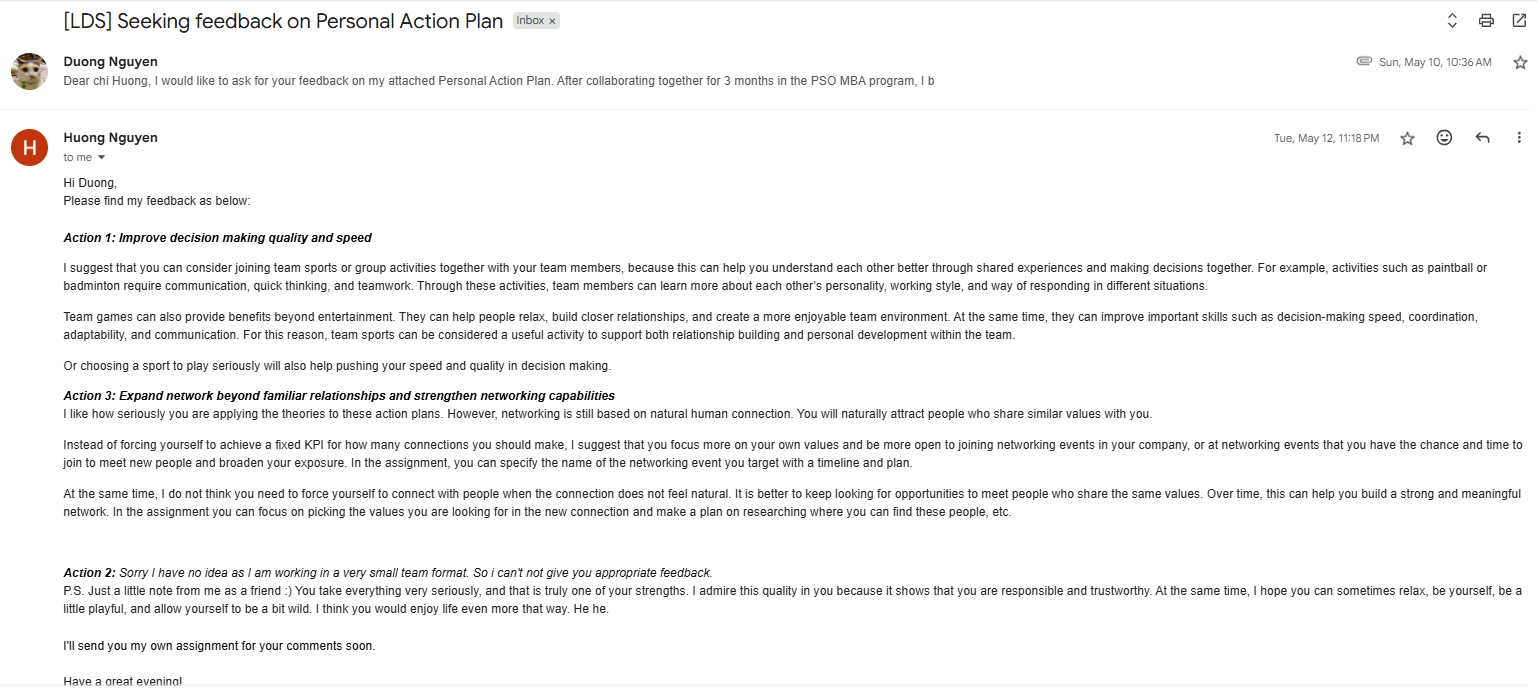
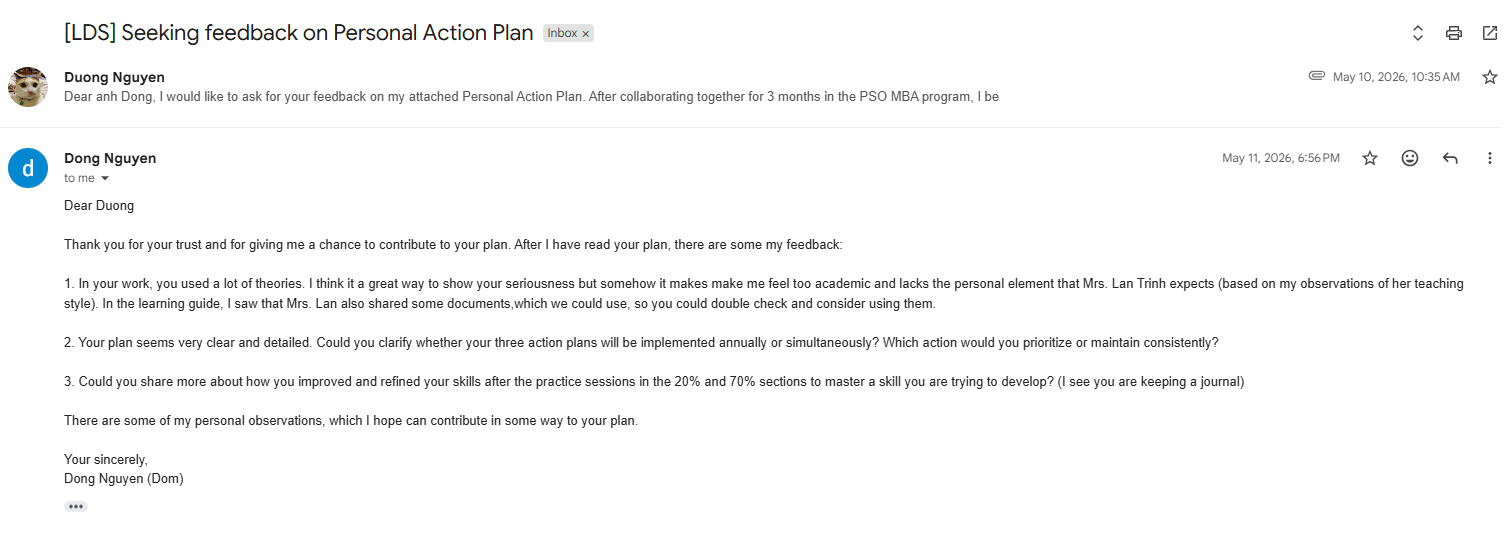
This development plan exists in its best form because of the people who took the time to engage with it seriously — not just to validate, but to challenge and push. Chi Huong and Anh Dong both gave constructive feedback that forced me to think harder, write more honestly, and design a plan that is more grounded in who I actually am rather than who I intended to present.

Chi Huong reminded me that genuine connection — built through shared experience, not just formal networking — is a more sustainable approach for someone with my profile. Anh Dong pushed me to drop the academic armor and bring more real voice into the work, and to make the learning cycles explicit rather than implied.

Both of these contributions have made it into the plan in a real way. I'm grateful for that kind of feedback — the kind that makes you better, not just more comfortable.